
BPPV: Why the Room Suddenly Spins (And How We Can Fix It)
Have you ever rolled over in bed and suddenly felt like the room was spinning out of control? Or tipped your head back to look at a high shelf and felt the world tilt sideways? If so, you may have experienced BPPV — and you’re not alone. It’s one of the most common causes of dizziness, and the good news is, it’s also one of the most treatable.
What Is BPPV?
BPPV stands for Benign Paroxysmal Positional Vertigo. That’s a mouthful, so let’s break it down:
- Benign — it’s not dangerous or life-threatening
- Paroxysmal — it comes on suddenly, in short bursts
- Positional — it’s triggered by changing the position of your head
- Vertigo — that spinning, whirling sensation
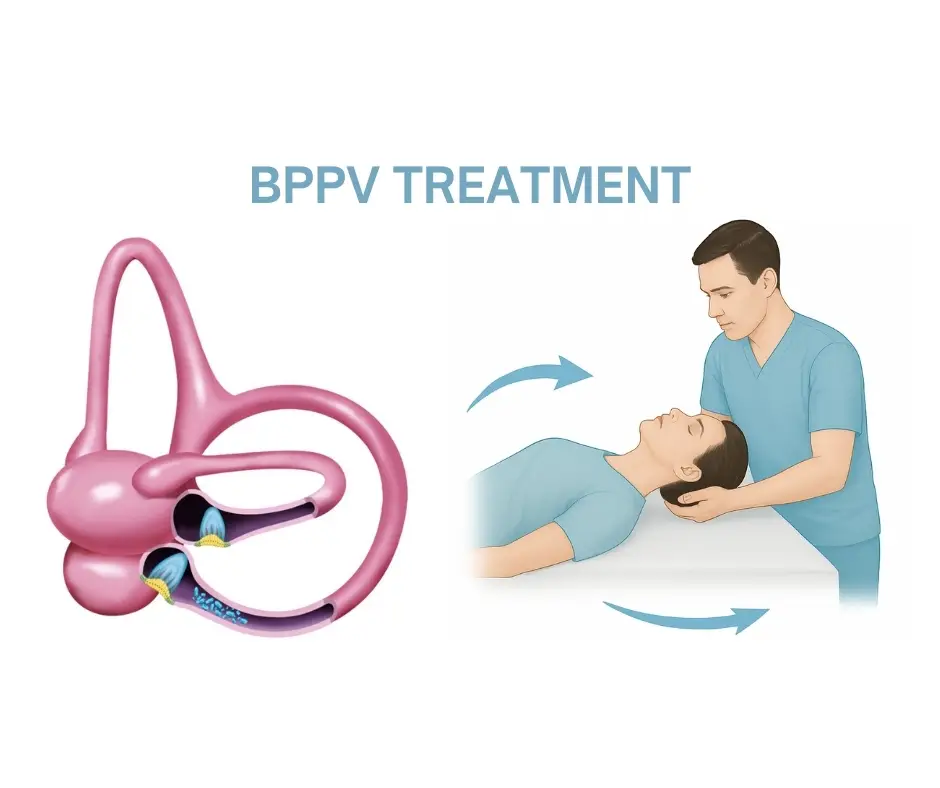
In simple terms: BPPV happens when tiny calcium crystals that normally sit in one part of your inner ear get knocked loose and drift into a part of the ear that controls balance. Your inner ear usually uses these crystals to help sense movement, but when they end up in the wrong spot, they send confusing signals to your brain every time you move your head a certain way. Your brain interprets those signals as spinning, even though you’re standing perfectly still.
What Does It Feel Like?
People describe BPPV in different ways, but the most common signs are:
- A sudden spinning sensation when you roll over in bed, sit up, lie down, or look up
- Episodes that are intense but usually short, often less than a minute
- Feeling queasy or nauseated during an episode
- Feeling a little “off” or unsteady even after the spinning stops
- Your eyes may flicker or jerk slightly during an attack (this is something your provider can observe)
It can be unsettling, especially the first time it happens. Many people worry they’re having a stroke or something more serious. While it’s always smart to get checked out, BPPV itself is not harmful — it’s just incredibly disruptive to daily life until it’s treated.
Who Gets BPPV?
BPPV can happen to anyone, but it’s especially common in:
- Adults over 50 (it becomes more common with age)
- People who’ve had a recent head bump or injury
- People recovering from a long illness or period of bed rest
- People with a history of inner ear problems
How Do We Know It’s BPPV?
Your healthcare provider can usually diagnose BPPV right in the office, without any scans or blood tests. They’ll guide you through a simple test where you sit on the exam table, then lie back fairly quickly with your head turned to one side. If this brings on the spinning sensation, along with some characteristic eye movements, that confirms the diagnosis and tells your provider exactly which side and which part of your inner ear is affected.
The Good News: The Epley Maneuver
Here’s the part you’ll be glad to hear: BPPV is one of the few causes of vertigo that can often be fixed in a single visit, with no medication and no surgery. The treatment is called the Epley maneuver, and it works by gently guiding those displaced crystals back to where they belong.
Think of it like shaking a snow globe until the flakes settle back into place. The Epley maneuver uses a specific sequence of head and body movements to coax the crystals out of the canal where they’re causing trouble and back into the part of the ear where they can rest harmlessly.
What Happens During the Maneuver
Your provider or physical therapist will guide you through it, so you don’t need to memorize anything. Here’s roughly what to expect:
- You’ll start sitting up on the exam table, with your head turned toward the affected side.
- You’ll lie back fairly quickly, with your head tipped back slightly off the edge of the table. You may feel a wave of spinning here. That’s normal, and your provider will have you hold still until it passes.
- Your head will be turned to the opposite side, and you’ll hold that position for about 30 seconds.
- You’ll roll onto your side, following your head, so you end up facing down toward the table.
- Finally, you’ll be guided back up to a sitting position.
The whole thing typically takes just a few minutes, and your provider may repeat it once or twice in the same visit to make sure it’s worked.
What to Expect After
- Many people feel noticeably better right away, though some lingering unsteadiness for a day or two is completely normal.
- You might feel a little woozy or “seasick” for the rest of the day. Take it easy.
- Your provider may suggest sleeping with your head slightly propped up for a night or two, and avoiding quick head-tilting movements for a day or so.
- For most people, one or two sessions does the trick. If symptoms continue, it can simply be repeated.
It’s worth knowing that BPPV can come back later, sometimes months or years down the line. That doesn’t mean anything went wrong. It just means those crystals shifted again, and the same simple fix usually works again too.
When to Seek Help Right Away
BPPV itself isn’t dangerous, but vertigo can sometimes be a sign of something else going on. Please seek medical attention promptly if your dizziness comes with:
- Double vision or trouble speaking
- Numbness, weakness, or trouble walking
- A severe headache unlike any you’ve had before
- Chest pain or fainting
Otherwise, if you’re dealing with that frustrating, room-spinning sensation whenever you move your head a certain way, know that help is available, it’s quick, and most people feel much better after treatment.
—
This article is for general educational purposes and is not a substitute for personalized medical advice. If you’re experiencing dizziness or vertigo, please talk to your healthcare provider.